The Next Generation of Wealthy Clients Is Already Deciding Whether You Deserve Their Business
They grew up with Amazon delivering packages in a day, Uber arriving in four minutes, and Spotify knowing what they wanted to hear before they asked. They have never had to wait on hold to check an account balance. They have never received a paper statement. They have never understood why moving money should take three business days. Now they are inheriting wealth — and they are evaluating every financial institution in their lives by the same standard they apply to everything else: does this experience deserve my continued attention?
The Benchmark Has Changed — and It Was Never the Competition
The most important thing to understand about next-generation wealth management clients is that they are not comparing advisory firms to each other. They are comparing the advisory experience to the best digital experiences in their lives: Apple, Amazon, Uber, Spotify, Robinhood. The standard is not "better than the other RIA across town." The standard is seamless, instant, personalized, and always available.
This is not a complaint about unrealistic expectations. It is a description of how an entire generation of high-net-worth inheritors has been trained, by the most sophisticated product designers in the world, to evaluate every interaction with every institution that asks for their time and their money.
EY's research on the great wealth transfer makes the stakes concrete: tens of trillions of dollars in assets are moving between generations in the coming decade. The firms that retain those assets will not be the ones with the longest track record or the most prestigious brand. They will be the ones whose client experience matches what next-generation inheritors expect — not as a luxury, but as a baseline.
The firms that fail to make that transition will discover that generational loyalty is not transferable. A Boomer client who has trusted the same advisor for twenty years does not guarantee that their Millennial inheritor will make the same choice. Without an experience worthy of the next generation, that relationship ends with the estate.
Six Digital Expectations That Wealth Management Must Meet
The expectations of next-generation affluent clients are not vague preferences. They are concrete, specific, and directly mappable to the gaps that exist in most traditional advisory experiences.
Account information, balances, and portfolio data available in real time — not in a quarterly PDF or a meeting scheduled for next week.
Every function accessible from a phone, not a desktop-only portal that requires a password reset every 90 days.
Recommendations and communications tailored to their specific situation, not generic market commentary sent to the entire client list.
Money that moves when they ask it to — same-day settlement, not a three-business-day ACH window that requires a follow-up call to confirm.
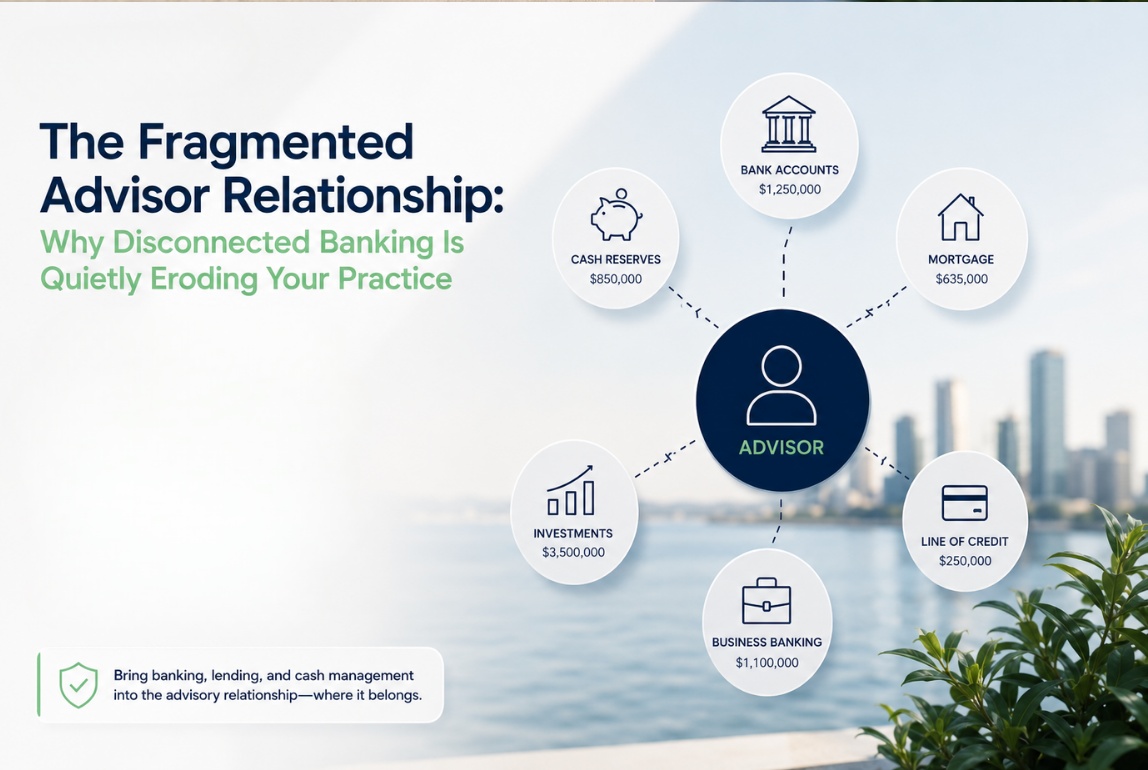
Investments, banking, cash, and lending visible in one place, not four logins across institutions that don't communicate with each other.
Advisors who reach out before clients need to ask, with relevant, personalized insights — not just responses to inbound calls.
None of these expectations are unreasonable. Every one of them is already met by the consumer technology platforms these clients use daily. The question is not whether wealth management firms should meet them. The question is which firms are prepared to, and which ones will lose the assets when it becomes clear they are not.
The Loyalty Problem: Why the Next Generation Will Leave
Institutional loyalty, the kind that kept clients at the same bank, brokerage, or advisory firm for decades, was always partly inertia. Switching was painful. The paperwork was tedious. The alternatives weren't obviously better. And for older generations who had built deep personal relationships with specific advisors, the relationship itself was the anchor.
Gen Z research on banking behavior consistently shows that these mechanisms no longer function. Digital-native clients switch financial institutions the way they change streaming services: without sentimentality, without paperwork friction (because every process is now digital), and without hesitation if the experience fails to meet their expectations. The cost of switching has collapsed. The threshold for switching has risen.
| Generation | Attitude Toward Financial Institutions | Institutional Loyalty |
|---|---|---|
| Baby Boomers | "I've been with my advisor for 20 years. I trust the relationship more than I'd trust starting over." | Very High |
| Gen X | "I value the relationship, but I expect modern tools. A bad digital experience would make me reconsider." | Moderate |
| Millennials | "I'll stay if the experience is good and the value is clear. Otherwise, I'll find something that works better." | Low |
| Gen Z | "I'm evaluating every financial relationship constantly. You keep me by being better, not by being first." | Very Low |
The loyalty gradient above represents a timeline, not just a demographic profile. As assets transfer from Boomers to Millennials and Gen Z, the high-loyalty portion of the wealth management client base is contracting. The firms that recognize this early and build the experience infrastructure to serve lower-loyalty, higher-expectation clients are the ones that will retain transferred assets. The others will watch the assets move to a competitor who made the investment they delayed.
Why Integration Is the Answer — Not Just Better Technology
The instinct in wealth management, when faced with a digital experience gap, is to invest in a better portal, a new mobile app, or a more polished client reporting tool. These investments are not wrong — but they are insufficient. Because the expectation that next-generation clients carry is not just for a better interface. It is for a genuinely integrated financial ecosystem.
The AI personalization trends documented in wealth management research point in the same direction: clients increasingly expect their financial institutions to know them comprehensively — their spending patterns, their liquidity needs, their life goals, their risk tolerance — and to deliver guidance and solutions that reflect that comprehensive understanding. That kind of personalization is structurally impossible when the advisory relationship covers only the investment portfolio while banking, cash, and lending exist somewhere else.
Wealth management modernization research consistently identifies integration — not just digital access, but genuine connection of banking, investments, lending, and cash management — as the primary differentiator between firms that retain next-generation assets and those that lose them. The firms that serve the next generation well are the ones that build the complete financial relationship before the transfer happens.
The Expectation Gap: Where Traditional Wealth Management Falls Short
The gap between what next-generation clients expect and what most traditional advisory experiences deliver is not subtle. It is visible in every interaction point — and it compounds across a client lifecycle in ways that are difficult to recover from once the pattern is established.
| Next-Gen Client Expectation | Legacy Wealth Management Reality | Fispoke-Enabled Advisor Reality |
|---|---|---|
| Real-time money movement | Two-to-three business day ACH transfers; wire instructions via email; manual confirmation calls | Same-day liquidity through embedded ACH capabilities inside the advisory platform — no separate banking portal |
| Integrated financial view | Investment portal only — banking, cash, and lending require separate logins at separate institutions | Investments, banking, cash management, and liquidity visible and managed within a single advisory relationship |
| Deposit safety without friction | Standard $250K FDIC limit; clients must self-manage multiple accounts for broader protection | Extended FDIC deposit protection distributed automatically — no multiple accounts, no operational complexity |
| Proactive, personalized guidance | Quarterly reviews; reactive communication; generic market updates | Full balance sheet visibility enables advisors to deliver timely, specific guidance across all client accounts |
| Banking-quality yield on cash | Idle cash in low-yield accounts; no competitive optimization within advisory relationship | Competitive yield access embedded in the advisory experience — alongside deposit protection and same-day liquidity |
| Lending within the relationship | Clients directed to separate mortgage and lending institutions; advisor loses visibility | Lending and credit solutions embedded within the advisor's ecosystem — no fragmentation, no lost visibility |
The right column of the table above is not aspirational — it is what Fispoke enables today for independent advisors who choose to build the integrated relationship that the next generation of wealthy clients will require.
Fispoke Builds the Advisory Relationship That the Next Generation Will Stay For
Every expectation that next-generation wealthy clients carry — instant liquidity, integrated financial visibility, competitive yield on cash, seamless banking, lending within the relationship, personalized guidance informed by the full financial picture — maps directly to a capability that Fispoke delivers inside the advisor's existing relationship.
Fispoke is not a technology upgrade layered onto a traditional advisory model. It is an architectural expansion of the advisory relationship itself — bringing the banking, cash management, and lending capabilities that the next generation expects into the advisor's ecosystem, where the advisor can see them, guide them, and connect them to the client's broader financial plan.
Modern Banking Experiences — Inside the Advisory Relationship
Fispoke enables advisors to offer integrated banking capabilities — real-time account visibility, competitive yield, same-day payment access — without directing clients to a separate institution. The banking experience the next generation expects becomes a feature of the advisory relationship, not a reason to maintain a parallel banking connection elsewhere.
Embedded Financial Products That Feel Native, Not Bolted On
Deposit protection, lending solutions, and liquidity management through Fispoke are native to the advisory relationship, not referrals to partner banks with separate onboarding, separate interfaces, and separate relationship managers. When next-generation clients experience Fispoke-enabled advisory services, the fragmentation they expect from financial services simply doesn't appear.
Fast Liquidity That Meets the Instant-Access Standard
Same-day ACH capabilities through Fispoke close the gap between what next-generation clients experience with consumer fintech and what they experience with their advisor. Money moves when they ask it to. Confirmation arrives automatically. The follow-up call that previously defined the transfer experience becomes structurally unnecessary.
Advisor-Centric Ecosystem That Deepens Over Time
Fispoke's platform creates an advisor-centric financial ecosystem — one in which the advisor is the hub of every significant financial decision, not just the manager of an investment portfolio. That centrality is exactly what drives the multi-decade relationship stickiness that the advisory industry needs to survive the generational wealth transfer.
Multi-Generational Retention Built Into the Architecture
When a client's children and inheritors are introduced to wealth management through a Fispoke-enabled advisory experience — modern, integrated, fast, and comprehensive — their first impression of the advisory relationship is shaped by an experience that meets their expectations. The transition from Boomer to next-generation client, which historically breaks advisory relationships, becomes a transition the firm is designed to survive.
The Bottom Line
The next generation of wealthy clients is not going to lower their expectations to match the advisory industry's traditional operating model. They are going to find the firms — or the platforms — that meet the expectations they already have. Fispoke gives independent advisors the infrastructure to be one of those firms: integrated banking, fast liquidity, embedded financial products, and a client experience that doesn't ask next-generation inheritors to accept a worse version of financial services just because their parents did. The firms that build that experience now are the ones that will still be managing those assets twenty years from now.
Sources & Further Reading
- EY — Winning Affluent Banking Clients in the Great Wealth Transfer
- Fidelity — Technology Modernization and Client Experience in Wealth Management
- Envestnet — AI Personalization and the Future of Advisor-Client Relationships
About Fispoke
Fispoke helps independent advisors deliver a more integrated financial experience by connecting banking, cash management, lending, and liquidity solutions within the advisor relationship. By reducing fragmentation and deepening client engagement, Fispoke enables RIAs to compete more effectively in an increasingly digital and relationship-driven financial landscape.
Ready to build the advisory experience the next generation expects?
Let's Talk — Fispoke.com